The modern university experience has transformed into a high-speed chase through a digital labyrinth. Between the endless stream of Slack notifications, Canvas dashboard updates, and the internal pressure to maintain a “perfectly productive” aesthetic on social media, the actual act of learning often gets buried. We spend hours “performing” the role of a student—organizing folders, color-coding digital planners, and scrolling through “study-with-me” videos—without ever entering a state of true deep work. This is the “busywork” trap. It creates a false sense of accomplishment while leaving our most important academic goals untouched and our mental energy completely depleted.
Stripping away this noise requires a fundamental shift in how we view our time and our tools. It is about identifying the tasks that actually move the needle on your GPA and career versus the tasks that just keep your hands moving. For instance, when a complex lab report or a difficult calculation feels like a brick wall, smart students don’t just stare at the screen for six hours in a state of paralysis; they find a specialized physics assignment helper from myassignmenthelp to bridge the knowledge gap. This isn’t about avoiding the work; it is about strategic delegation. By clearing out the technical roadblocks that cause procrastination, you free up your cognitive resources to focus on the high-level concepts that truly define your expertise and academic success.
The Science of Cognitive Load and Student Burnout
Our brains were not evolved for the hyper-connected, multi-tab environment of 2026. Every notification and every unnecessary sub-task creates “cognitive load”—a mental tax that reduces your capacity for critical thinking. When your brain is busy managing fifty different micro-tasks, you lose the ability to enter “flow,” that state of deep concentration where time disappears and your best work happens.
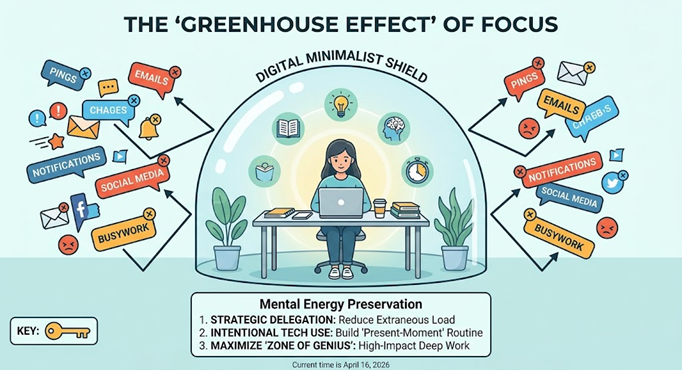
To truly focus, you must adopt a minimalist mindset, treating your attention as your most valuable currency. Think of your mental energy like a delicate ecosystem. Much like how the Greenhouse Effect involves the trapping of heat to maintain a balanced environment, your study habits should trap and preserve your focus rather than letting it leak out into the atmosphere of social media and meaningless busywork. Without this balance, your internal “climate” becomes overheated, leading to the inevitable burnout that many students face by mid-semester.
The Audit: High-Value vs. Low-Value Tasks
To strip away the busywork, you must first define it. Most students treat all tasks as equal, but in reality, they follow the Pareto Principle: 20% of your activities produce 80% of your results.
| Task Category | Examples | Value Level | Impact on Ranking/GPA |
| Deep Work | Thesis drafting, synthesizing sources, solving complex formulas. | High | Primary driver of success. |
| Critical Learning | Participating in seminars, peer review, primary research. | High | Builds long-term expertise. |
| Logistics | Organizing folders, finding templates, formatting citations. | Low | Necessary but time-consuming. |
| Performative Study | Color-coding notes, watching “vlogs” of people studying. | Zero | Pure procrastination. |
If you find yourself spending more time selecting a font for your presentation than verifying the data within it, you are trapped in a low-value cycle. The goal is to maximize the top two rows while ruthlessly delegating or automating the bottom two.
1. The Digital Declutter: A 2026 Essential
Digital minimalism isn’t about living like a hermit; it’s about intentionality. Your laptop and smartphone should be precision tools, not masters that dictate your schedule.
- The Notification Purge: Turn off every notification that isn’t from a real human being. You do not need to know the second a new video drops or when an app has a sale. If it’s important, it will be there when you check on your terms.
- The Single-Tab Rule: Multitasking is a myth. Every time you switch from a research paper to a text message, it takes your brain an average of 23 minutes to fully return to the original level of focus. Work on one tab, one task, and one goal at a time.
- Analog Mornings: Spend the first hour of your day away from screens. Use this time to journal, move your body, and plan your “Big Three”—the three most important tasks that must be finished today to consider the day a success.
2. Mastering Strategic Delegation
One of the biggest lessons students can learn from the corporate world is that “doing it all” is a recipe for mediocrity. In a professional setting, a manager doesn’t spend their time filing paperwork; they focus on strategy and growth because that is where their value lies.
As a student, you should apply this same logic. If you are a brilliant writer but struggle with the repetitive data entry for a statistical analysis, find ways to streamline that specific hurdle. Using professional support for the repetitive or highly technical parts of a project—such as using myassignmenthelp for heavy-duty research or drafting—allows you to maintain your “Zone of Genius.” This creates a more polished final product and ensures you aren’t sacrificing your mental health just to hit a deadline.
3. Building a “Present-Moment” Schedule
Consistency beats intensity every single time. A student who studies for two focused hours every day with zero distractions will always out-perform the student who pulls a 12-hour “all-nighter” fueled by caffeine and panic.
- Time Blocking: Give every hour of your day a specific job. If you have an hour blocked for “Dissertation Research,” your phone stays in another room.
- The “Done” List: Traditional To-Do lists can feel overwhelming and never-ending. Instead, keep a “Done” list. At the end of the day, write down everything you achieved. This builds the dopamine associated with progress and helps you realize how much time was actually spent on things that didn’t matter.
The Shift to “Information Gain”
In the era of generative search and AI-driven results, the way Google ranks content has changed. It no longer looks for the longest article; it looks for Information Gain. This refers to the unique, human insight that isn’t already found in a thousand other places on the web.
When you strip away the busywork, you give yourself the “boredom” required for this level of creativity. It is in the quiet moments, away from the pings and scrolls, that your best ideas surface. Whether you are writing an essay on environmental policy or solving a complex physics problem, the goal is to produce work that reflects a unique human perspective. By delegating the mechanical “busywork” of education, you allow yourself the space to be a thinker, not just a processor.
4. Navigating Academic Pressure in a Global Context
Academic standards vary globally—from the rigorous citation requirements in the UK to the application-heavy assessments in Australia. Trying to master every local nuance while also learning core subject matter is a massive source of “extraneous” busywork.
By using expert resources, you aren’t just getting help with a task; you are gaining a localized roadmap. Professional platforms provide the structural “physics” of a high-distinction paper, allowing you to focus on the actual content and arguments. This global mindset helps you prepare for a career that likely won’t be confined to a single city or country.
Conclusion: Reclaiming Your Education
Education should be a process of transformation, not just a series of boxes to check. By embracing digital minimalism, you stop being a passive consumer of information and start being an active creator.
Identify your “Greenhouse” of focus, delegate the technical hurdles of the workload when they become a barrier to learning, and ruthlessly cut out any task that doesn’t contribute to your long-term growth. When you focus on what actually matters, the grades follow naturally, but more importantly, so does the satisfaction of knowing you’ve truly mastered your craft.
Stripping away the busywork isn’t about doing less; it’s about doing what matters most. In a world of noise, your focused attention is your greatest competitive advantage. Use it wisely.
Frequently Asked Questions
What exactly is “busywork” in a student context? Busywork refers to low-impact tasks that consume time without improving your understanding of a subject. This includes over-formatting notes, repetitive digital organizing, or “performative studying” that feels productive but doesn’t contribute to your final grades or skill development.
How does digital minimalism improve academic performance? By reducing digital distractions and notification fatigue, you lower your brain’s cognitive load. This allows you to reach a state of “deep work,” where you can solve complex problems faster and retain information more effectively than through distracted, multi-tasking study sessions.
Is delegating certain academic tasks considered a skip in learning? Strategic delegation is about efficiency. By focusing your energy on high-level synthesis and core concepts while seeking assistance for technical roadblocks or repetitive research, you mirror professional management styles that prioritize results and specialized expertise over manual labor.
What is the best way to start a digital declutter? Begin with a notification audit by silencing all non-human alerts. Follow this with a “single-tab” policy during study blocks and dedicate the first hour of your day to analog planning. These small shifts build the mental discipline needed for long-term focus.
About The Author
Min Seow is a dedicated academic strategist and content specialist who focuses on streamlining the student learning experience. Through her work with myassignmenthelp, she provides actionable insights into productivity, helping students navigate complex educational landscapes with efficiency and clarity.